Bhai Santokh Singh
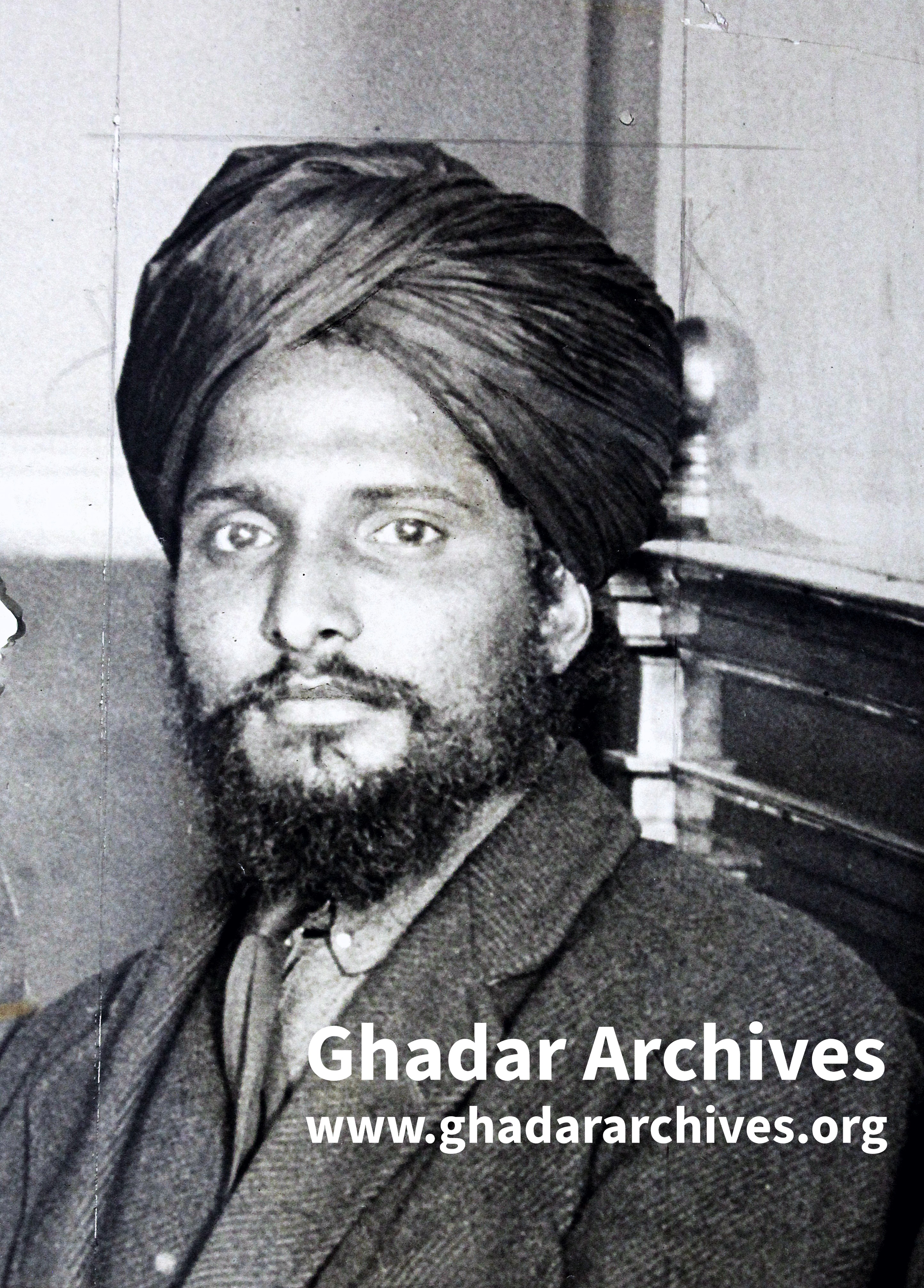 Bhai Santokh Singh was a resident of village Dhardeo, District Amritsar. His father lived in Malaya State and he was born there too. His formative years were spent in Malaya and got his primary education there too. Later, he came to India and got admitted to Khalsa College Amritsar for higher education. It had been two years since he came here and he got an urge to go to America for education. Around 1911, he arrived in New York and from there he went to Canada. After listening to the miseries of the Canadian migrant Indians, he dropped the idea of studies and started to participate in the political affairs. For his living, he started labour jobs.
Soon after being in Canada, on the advice of his friends, he went to Baba Jwala Singh, in Holt, America and started working with him on his agricultural farm. Incidently, Lala Har Dayal was there in those days too. Bhai Santokh Singh was among the people who proposed to invite students from India to get them higher education and he had taken the responsibility to meet their expenses. At the constitution of the Ghadr Party, he was elected as a member of its Central Committee and when the Ghadr Party started to send groups of people to India, he left his job and arrived in Siam. He had a big role in the army rebellion that took place in Singapore. Because of being born in Malaya, he was well conversant with the local language.
Bhai Santokh Singh was a resident of village Dhardeo, District Amritsar. His father lived in Malaya State and he was born there too. His formative years were spent in Malaya and got his primary education there too. Later, he came to India and got admitted to Khalsa College Amritsar for higher education. It had been two years since he came here and he got an urge to go to America for education. Around 1911, he arrived in New York and from there he went to Canada. After listening to the miseries of the Canadian migrant Indians, he dropped the idea of studies and started to participate in the political affairs. For his living, he started labour jobs.
Soon after being in Canada, on the advice of his friends, he went to Baba Jwala Singh, in Holt, America and started working with him on his agricultural farm. Incidently, Lala Har Dayal was there in those days too. Bhai Santokh Singh was among the people who proposed to invite students from India to get them higher education and he had taken the responsibility to meet their expenses. At the constitution of the Ghadr Party, he was elected as a member of its Central Committee and when the Ghadr Party started to send groups of people to India, he left his job and arrived in Siam. He had a big role in the army rebellion that took place in Singapore. Because of being born in Malaya, he was well conversant with the local language.
At the time when he came to Siam from Singapore, Babu Harnam Singh, Bhai Bhagwan Singh and Bhai Balwant Singh, some Canadians and American Indian residents had been exiled and had arrived there too. All of them got together and started to work among Indian armed forces posted in Burma. At the time, when arrests were being made in India, Siam and Burma, he was successful to escape to Japan.
The story of his escape from police in Siam is very challenging. Police went to his house to arrest him, but he had already got the news, so he walked away towards a forest. Police too, followed him. It was a day of torrential rain and the forest had turned into an ocean. He was on the run while the police were chasing him falling and slipping over the obstacles. After a little while, they reached a stream which had flooded due to the rains. He did not know how to swim. He had two options in front of him at that time. Either to get arrested and be hanged, or if survived while crossing the stream come back to serve the country. Finally, he took a chance to try his luck and jumped into the river. Water was flowing upto his chest height. He was successful in crossing the river. In the meantime, the police also arrived at the river shore. Police were unable to decide yet that whether or not they should chase him after crossing the river and exactly at that time there was a high tide in the river because of the gushing water. So the police could not chase him and he escaped to Japan and from there to America. The role that he played to solve the rift in the Ghadr Party, had already been mentioned. He was sentenced to two years in jail in America's Hindu Conspiracy Case. After his release, the American Government wanted to deport him but due to the public opinion and pressure, it could not be done. In 1922, the Ghadr Party directed him to go to India via Russia. His inclination towards Socialism had started in the American jail. This is the reason, after arriving in India, he started to campaign for Socialism.
When he came to Iran from Russia, he was arrested in Tehran, but was released after few days. From there he reached Mashhad and from there he walked on foot to the city of Herat, in Afghanistan. He travelled from Herat to Kabul via Ghazni. Because of being a desert, this route was a very difficult one. On the way, he became sick with cholera. Where would the medicine come from in that barren land? He had heard that the last remedy for this disease is water. If the patient is bathed in the water he would, either get cured instantly or die immediately. He said his prayer and bathed in cold water. It was nature's miracle that he got well instantly.
When he reached Kabul, Bhai Gurmukh Singh and Master Udham Singh met him. These two had been jailed for life in the Labore Conspiracy Case, but after breaking through the jail they escaped to Kabul. After a brief stay in Kabul, Bhai Santokh Singh started for India. There is one river that flows from Afghanistan to Peshawar. When he reached Indian border after crossing the river on a 'mashak (leather waterskin bag), the British police arrested him. In those days, "Gurdwara Sudhar Lehar' (Gurdwara Reforms Movement) was at its penk among the Sikhs in India and Shiromani Gurdwara Committee's (Sikh religious council's) first group of Sikhs had been arrested. Bhai Santokh Singh was able to meet some of the top "Akali" (political party of the Sikhs) leaders while in jail, with whose efforts, he was released after six months and on a bail on promise of good conduct for one and half year. Had he been arrested in 1914, he would have certainly been hanged, but the situation had changed now.
After peacefully passing the one and a half year period of bail, he again decided to work for his country's freedom. First of all, he gathered persons who had returned from America and Canada and motivated them to work together. Apart from that he, along with these friends, formed a new organisation and it was named as 'Kirti Kisan Party (Proletarian Farmer Party). To campaign about the mandate of this party, a monthly magazine in the name of "Kirti (Proletarian) was started in Gurmukhi from the city of Amritsar. Its first publication came out in 1926. After running, it successfully for some time, it was also started in the Urdu language. All of this was being done under his supervision. Socialism was being propagated through these newspapers. The awareness that is being seen among the Punjab's proletarian farmers, is mainly because of his dedication.
Unfortunately, he did not get much time to serve the country. It had been a short time since the start of these newspapers that he got sick with tuberculosis. In April 1927, he died and left his friends forever. It is important to mention about his thinking, that along with Socialism, he maintained full faith in his religion too. During all the difficult times, he always kept with him a miniature copy of the 'Guru Granth Sahib (The holy book of the Sikhs). He would not start anything without obtaining a sermon from it. He went on to this extent that even for the start of the Kirti Newspaper he obtained 'Hukamnama (Lord's sacred order) from the Guru Granth Sahib and published it on the first edition of the newspaper. He led a very simple life and would eat very little. He never thought about luxuries in life. Because of not being considerate about his diet, he died at a young age. After the failure of the freedom movement of 1914, he was the first one among the patriots who had retumed from America to start a mission for the country's freedom. The Kirti Party Movement, for which he had laid the foundation, had later joined the Communist Party now and it should be considered as the Punjab Communist Party.